Auto Europe




Blog Search
Categories
Searching Blogs......
Uncover the history of Petra
Who were Nabataeans? This mysterious folk has been puzzling historians to this very day. History says they were a nomadic people whose empire extended across modern-day Yemen into Sinai Desert. However, no one can be certain about this. Probably the most perplexing trait of Nabataeans' history is a complete lack of written evidence despite their widespread literacy. It is believed that almost every person, including shepherds, could read and write!
History of Petra and the Nabataeans
Their origins, along with their nomadic lifestyle and trade routes across the desert, remain somewhat obscure. Nabataeans' lifestyle was nomadic in nature, therefore it is not surprising that at first they did not build any houses, temples or permanent settlements. Or so it seems, since Petra, a unique city carved in a rock and a masterpiece of ancient architecture, is their legacy to the world.
The news about the city of Rekem spread quite fast in the ancient world, it even reached China. This commercial hub and the capital of Nabataeans grew to be a meeting point for the western and eastern goods, and a central place for trade. Moreover, the city thrived as Nabataeans learned how to control water supplies in the desert, as well as to sell water from flash floods. An estimated 30,000 people lived in the city during its peak time. Annexed to the Roman Empire, the name of the city was changed to its nowadays known version - Petra, meaning stone. A devastating earthquake in 4AD, along with the change of trading routes, was one of the final contributing factors to Petra's consequent decline.
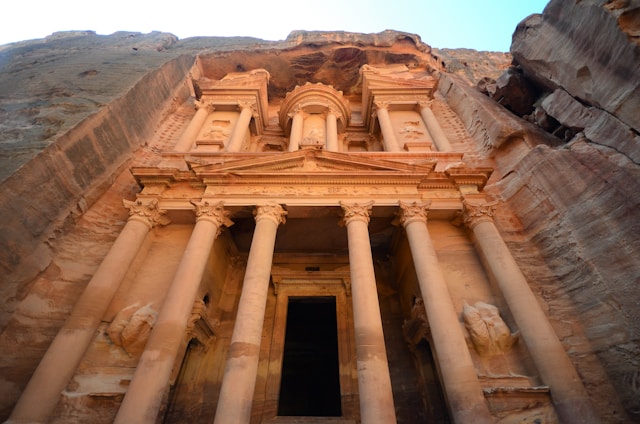
Petra's unique location in southern Jordan, amid a hidden canyon in the dessert provided the much needed protection for tradesmen in the city's heyday. A narrow gorge known as the Siq, created by water over time, leads straight into the city. At times it is over 68 feet tall and only 6.5 feet wide. Cut into the rock, you will see a number of carvings and shrines throughout the Siq, some of them overnight lodgings for travellers back in the day. As you reach the end of the path, a truly spectacular view is sure to leave you impressed. At the end of the Siq, the most famous site in Petra - the Khazneh, or Treasury - awaits the traveller. The well-known landmark, an imposing facade carved into the red rock, is simply breathtaking. Impressive in its size which gave Petra the monicker of a lost city of giants, it is only one of around 800 structures in Petra. Curiously enough, only the facades, sculptures and columns reflect elaborate design, heavily influenced by the Greek, Roman and Egyptian architectural styles. The interiors, however, are completely unadorned. It could be perhaps down to the fact they were used as tombs for the wealthy, not as homes.
UNESCO lists Petra as a World Heritage site, and it has recently acquired the flattering title of one of the 7 New World Wonders. Petra is abundant with history and mystery. Its red coloured rocks, intricate facades and monuments will not only sweep you away with their beauty, but they will also instantly transport you to some other little-known age.
Blog Search
Categories
- Home
- Travel Blog
- Petra